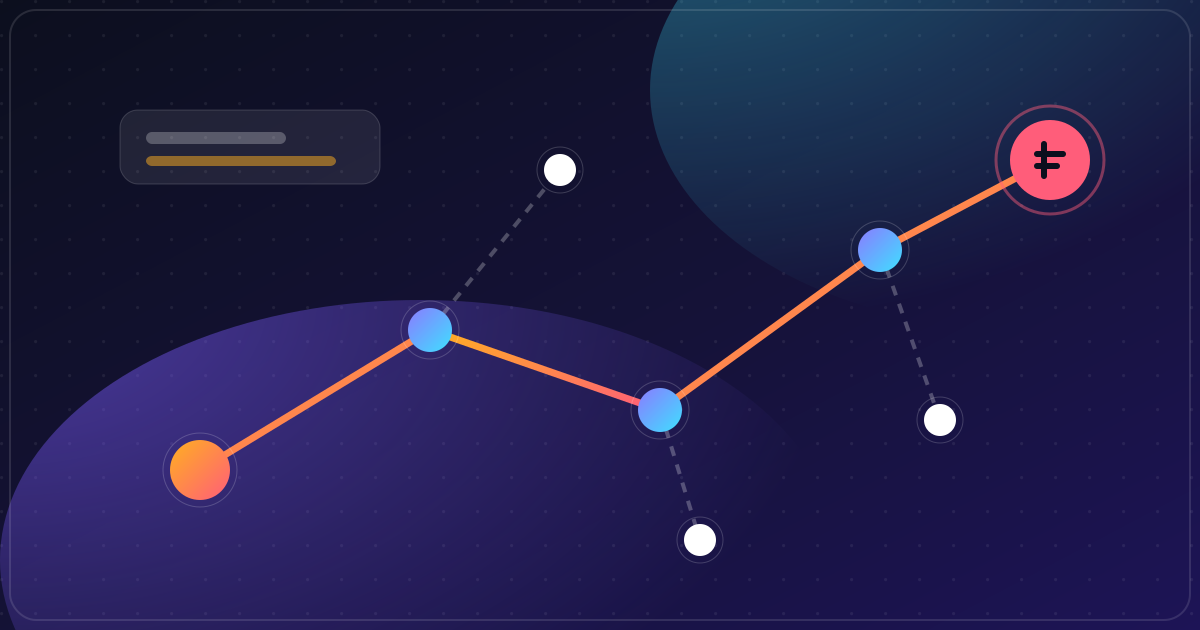
The good news about crypto theft: every movement is recorded forever on a public ledger. The bad news: thieves know that too, and they split, hop and mix funds to exhaust anyone following them. Tracing is the discipline of following value through that maze faster than it dissolves. This guide walks through how multi-hop graph analysis works, the obfuscation patterns you will meet, and what to do in the critical first hours after a theft.

Why tracing works at all
Blockchains are append-only: a thief can move funds but can never erase where they came from. Analysis tools reconstruct the transaction graph — wallets as nodes, transfers as edges — and attach labels from a database of known entities. Arya Crypto's engine draws on 7M+ labeled entities across 43 networks, so when stolen value reaches a known exchange deposit address, a mixer or an OTC broker, the graph says so explicitly.
The patterns thieves actually use
Most theft flows are variations of a few motifs:
- Peel chains: a large balance moves in a long series of transactions, \"peeling\" a small slice to a cash-out address at each step while the remainder rolls forward to a fresh wallet.
- Fan-out/fan-in: funds split across dozens of wallets, then reconverge at a consolidation address — the reconvergence is what analysis catches.
- Cross-chain hops: value bridges to another network to break naive single-chain tracing; multi-network coverage is non-negotiable.
- Mixers: genuine obfuscation, but entering and exiting amounts and timing still leak statistical signal — and mixer deposits themselves are a red flag every screening engine sees.
Exchanges are the choke points
Almost every thief eventually needs an exit into spendable money, and that means touching a service with KYC records — an exchange, an OTC desk, a payment processor. That deposit is the investigator's prize: a regulated entity that can freeze funds and, with a legal request, disclose an identity. This is why speed matters — a freeze request that reaches the exchange while funds still sit in the deposit wallet is worth more than a perfect report a month later.
What victims should do first
In the first hours: record the theft transaction hashes, screen the destination addresses, and put every address in the outflow under continuous monitoring so you are alerted the moment funds move again. Generate the PDF report of the trace — timestamps, path, risk categories — because exchanges and police both respond faster to structured evidence than to a story. Then file with law enforcement in your jurisdiction; realistic recovery runs through legal channels, and your trace shortens their work dramatically.
Tracing as prevention
The same graph analysis that chases stolen funds also prevents you from receiving them. Screening a counterparty before settlement reveals whether their funds sit a few hops from a fresh theft — exposure you do not want on your books. One check before the transaction is cheaper than a forensic investigation after it.
Reading a transaction graph without getting lost
The first time you open a multi-hop graph it looks like an explosion of nodes, and the instinct is to follow every branch. That instinct is what makes tracing feel impossible.
Experienced investigators do the opposite: they prune aggressively. Follow value, not transactions. A branch carrying 0.4% of the stolen amount is noise; the branch carrying 60% is the case. Follow that one until it reaches a service, and ignore the rest until you have.
Watch for the shape too. Funds splitting into many equal amounts is deliberate obfuscation. Funds sitting still for weeks then moving in one hop usually means the thief was waiting for attention to fade. Neither pattern is proof of anything on its own, but both tell you where to look.
What entity attribution adds
Raw graph analysis shows you addresses. Attribution tells you what those addresses are, which is the difference between a diagram and a lead.
Analysts cluster addresses that provably belong to one actor using on-chain heuristics — common-input ownership, change-address patterns, timing correlations — then label those clusters from off-chain evidence: court filings, exchange disclosures, seized infrastructure, scam reports. That is why a database of 7 million labeled entities matters more than a list of addresses.
In a trace, attribution is what turns "funds went to this address" into "funds reached a deposit address at a named exchange" — and that second statement is the one law enforcement can act on.
Documenting a trace so it can be used
A trace that lives only in an analyst's browser tabs is not evidence. If you want it to support a law-enforcement report, an insurance claim or a civil action, it has to be reproducible by someone else.
Record the starting address and the exact transaction hashes at every hop, with timestamps. Note the value share carried by each branch you followed and, just as importantly, why you discarded the ones you did not. Export the screening reports for the key addresses so the risk findings are timestamped rather than asserted.
Every check on Arya Crypto produces a downloadable PDF containing the score, category breakdown, matched sources and counterparties — which is what makes a trace defensible months later rather than merely persuasive today.
Realistic expectations about recovery
Tracing and recovery are not the same thing, and conflating them causes a lot of wasted effort and false hope.
Tracing is technical and usually succeeds: the blockchain is a permanent public record, so with enough patience you can normally follow value to wherever it came to rest. Recovery is legal and jurisdictional. It depends on whether the funds reached a service that responds to legal process, whether that service is in a cooperative jurisdiction, and whether the amount justifies the cost of pursuing it.
The honest position is that a good trace substantially improves your odds and is a prerequisite for any recovery, but it does not guarantee one. Anyone promising guaranteed recovery in exchange for an upfront fee is running a second scam on the victim of the first — a pattern common enough to be worth naming.
Preventing the next incident
Most of what makes tracing hard is time. The longer funds move unnoticed, the more hops accumulate and the more services they pass through. So the highest-value use of this technology is not investigation after the fact — it is noticing sooner.
Put your treasury and settlement addresses under continuous KYT monitoring, so an unexpected outflow or a new high-risk counterparty raises an alert within hours rather than being discovered in a monthly reconciliation. Screen withdrawal destinations before releasing funds, which stops the outbound leg of many thefts outright.
And keep identity verification current on the accounts that can move money, because a trace that ends at your own platform is only useful if you know who was behind the account.
Trace an address across 43 networks — Pricing · Services · KYT · KYC · KYB · Exchange · Prop